NADIA & yaesil
Open to Work 2026
Financial Planning Solutions for Caregivers
CuroNow - Financial Team
A comprehensive research and design initiative aimed at simplifying the complex financial landscape for family caregivers. We focused on creating tools that facilitate collaboration, expense tracking, and long-term planning with clarity and empathy.
Role
UX Designer
Tools/Skills
Figma
Team
3 UX Designers, 1 Project Manager
Duration
8 Weeks
Overview
The CuroNow project addressed a critical gap in the financial services market for family caregivers. Through extensive user research and iterative prototyping, we developed an intuitive interface that streamlines the management of shared household and care-related expenses. By focusing on accessibility and emotional intelligence, the resulting design empowers caregivers to focus on what matters most: the well-being of their loved ones.
Navigating Financial Uncertainty While Caring for Someone Else
Caregiving is often an unplanned journey that brings not only emotional strain but significant financial complexity. Caregivers frequently find themselves managing multiple sets of finances—their own and those of their loved ones—without the proper tools to track shared expenses, coordinate with other family members, or plan for the long-term impacts on their own retirement and savings. This lack of clarity leads to high levels of stress and friction within families, complicating an already challenging season of life.

“Managing my mom’s bills while trying to save for my own future feels like I’m constantly choosing between her care and my safety net.”
– Caregiver, online caregiving community

Family Caregiver
Family caregivers often balance their primary jobs, loved ones’ health, and financial uncertainty. Our goal was to design tools that make managing caregiving finances clear and supportive, so that caregivers can put energy back into themselves.
BACKGROUND
A 42-year-old business-owner and mother, Maddie also cares for her aging mother. Between work shifts and family duties, she struggles to keep track of bills, insurance, and caregiving costs.
FRUSTRATIONS
Managing finances across multiple apps and documents is overwhelming. Maddie often forgets due dates and isn’t sure what’s covered or deductible. She wants a stress-free way to stay financially organized.
User Research
Research with a Tight Timeline and Budget
The team was working with an eight-week timeline and no project-specific research budget. To work around this constraint, we leaned heavily on indirect research methods to capture the emotional and practical realities of caregiving.
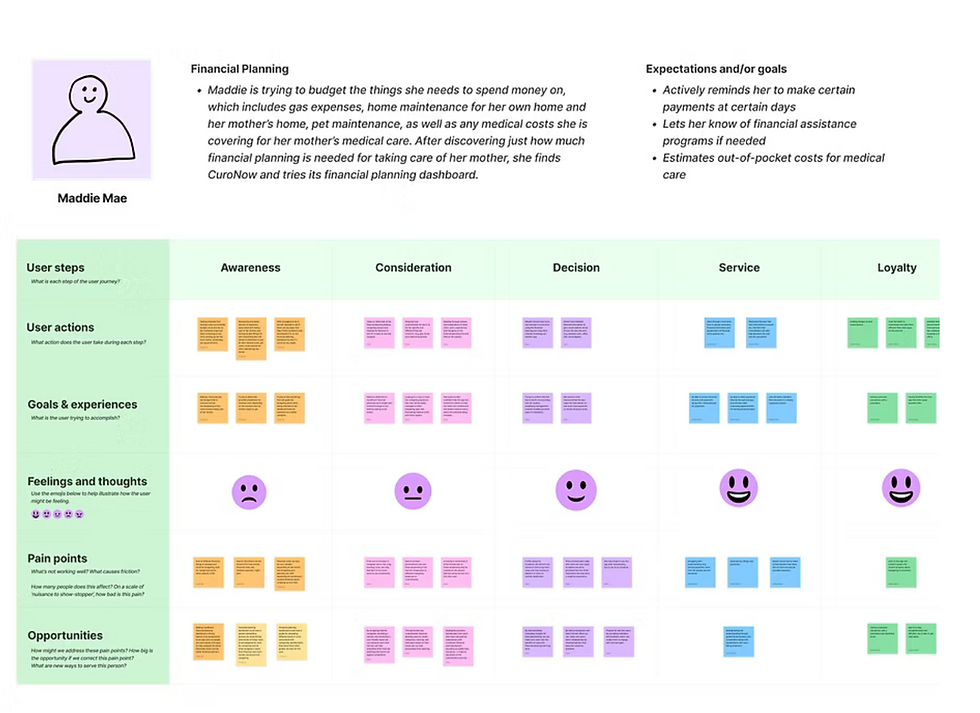
We turned to online caregiver stories, community threads, and video diaries. By analyzing content from platforms like YouTube and specialized caregiving forums, we were able to synthesize a high volume of firsthand experiences. We used transcriptions and direct quotes to conduct affinity mapping and journey mapping sessions.
This research revealed that caregivers were managing deep-seated fear and guilt alongside their spreadsheets. The key insight was that caregivers didn't just need better math; they needed a financial experience that acknowledged their emotional labor and validated their efforts.
Research Insights
Financial Frustrations and Emotional Themes
1
Fragmented workflows
Caregivers toggled between apps, bills, and spreadsheets just to stay afloat.
2
Unpredictable Expenses
Sudden medical or home-care costs created constant anxiety.
3
Mismatched Tools
Existing apps assumed one user with stable income, not two or more interconnected lives.
4
Emotional Fatigue
Managing finances often triggered guilt and stress rather than control.
User Research
Hypothesising Finance Needs and Success
We started with core financial features from CuroNow’s Lead UX designer and used research to shape hypotheses. Connecting caregiver needs to assumptions and success metrics helped us refine the project scope. Refinement involved validating caregivers need for emotional support as much as logic.
Bill Payment
Hypothesis: Caregivers need a single portal to manage and automate bills for multiple households to reduce late fees and mental load.
Financial Planning
Hypothesis: Long-term forecasting tools will help caregivers protect their own retirement savings while funding care.
Budgeting
Hypothesis: Simplified tracking of shared expenses will settle family disputes and improve transparency between siblings.
Insurance Management
Hypothesis: A centralized repository for policies and claims will speed up reimbursement times for medical expenses.
Tax Management
Hypothesis: Identifying deductible caregiving costs in real-time will maximize annual tax returns and provide immediate financial relief.
Estate Planning
Hypothesis: Early documentation of assets will prevent legal complexities and ensure the loved one’s wishes are honored.
How Might We Statements
Bringing Structure to Uncertainty
I further defined our user needs by developing a set of “How Might We” questions that shaped our design direction. As I clarified our goals, I saw the need to deepen our understanding of caregiving finances, especially budgeting, tax management, and everyday financial decision-making. I researched these areas and created a shared reference guide for the team, grounding our solutions in realistic financial workflows and best practices.

HOW MIGHT WE
Centralize caregiving finances so users can see everything in one place

HOW MIGHT WE
Make financial management feel human rather than clinical

HOW MIGHT WE
Support unpredictable expenses without overwhelming them
Wireframing
From Scattered Tasks to a Single System
Early sketches and competitor research on various budgeting, planning, and tax management mobile apps like NerdWallet and Every Dollar helped me explore how larger competitors combine these information-heavy tasks under a single visual language. I then drew out multiple layout options using Crazy 8 ideation, aiming for a calm, collective interface rather than a flood of numbers. We decided to group information by mental model rather than data type.
"What I need to track" "What I need to pay" "What’s coming up."

Design Opportunity
Designing personalization, not one-size-fits-all
Qualitative research showed that financial needs and confidence varied widely between caregiver situations. Some were managing immediate crises while others were planning for long-term transitions, creating a spectrum of urgency and expertise.
We introduced a personalized onboarding flow so caregivers could identify their financial focus areas — such as budgeting, insurance, and tax management — and their comfort level. The resulting dashboard adapts to those selections, providing relevant insights without overwhelming the user.

Stakeholder Insight
Understanding Multi-Household Management
Placeholder text: We conducted session with key stakeholders to identify the primary pain points in managing complex financial flows between caregivers and their family members. This initial phase was crucial for setting the technical foundation of the app.
Placeholder text: The sessions revealed that data isolation was the biggest barrier to effective care. By bringing these disparate pieces of information together, we could create a more holistic view of the financial health of the entire care circle.
Core Questions
1
How do we capture all care-related spend?
2
Who needs access to the financial dashboard?
3
What level of automation is safe and helpful?
Key Iterations
Applying Feedback for Realistic Caregiving
Automating Mundane Tasks
We introduced recurring bill payments and smart expense categorization to reduce the cognitive load on caregivers managing daily finances.
Collaborative Planning Tools
The iteration focused on multi-user access for family circles, ensuring siblings could see shared caregiving costs with transparency and ease.
Emotional Support Integrations
We adjusted the dashboard to lead with peace of mind insights rather than just raw numbers, validating the emotional labor of caregiving.

Guided Learning with AI
CuroNow uses AI to categorize expenses and provide proactive financial advice, helping caregivers navigate complex financial scenarios with ease.
Smart Tax Management
Automatically flag caregiving expenses that may be tax-deductible. Curonow keeps you organized for tax season, ensuring no savings are missed.
Personalized Dashboard
The core of CuroNow is a dashboard that adapts to your unique financial focus. Whether you're tracking medical expenses or planning for long-term care, your dashboard leads with peace of mind insights rather than just raw numbers, validating the emotional labor of caregiving.
Flexible Budgeting
Tracking shared household and care-related expenses has never been simpler. Intuitive tools help reconcile sibbling contributions and keep care-circle planning transparent and empathetic.
Final Prototypes
A Design That Lets Families Focus on Care, Not Calculations
The CuroNow project addressed a critical gap in the financial services market for family caregivers. Through extensive user research and iterative prototyping, we developed an intuitive interface that streamlines the management of shared household and care-related expenses. By focusing on accessibility and emotional intelligence, the resulting design empowers caregivers to focus on what matters most: the well-being of their loved ones.
[ Figma Prototype Embed Area ]
Reflection
Learnings and Next Steps
Working on the CuroNow project deepened my understanding of the emotional complexities involved in caregiving. I learned that designing for financial security is not just about numbers and tracking; it is about providing clarity and peace of mind during highly stressful life transitions. The empathy gained through user stories was the most valuable component of this case study.

Next steps:
I plan to refine the high-fidelity mockups by conducting further accessibility audits, specifically focusing on cognitive load and screen reader patterns for complex financial dashboards.